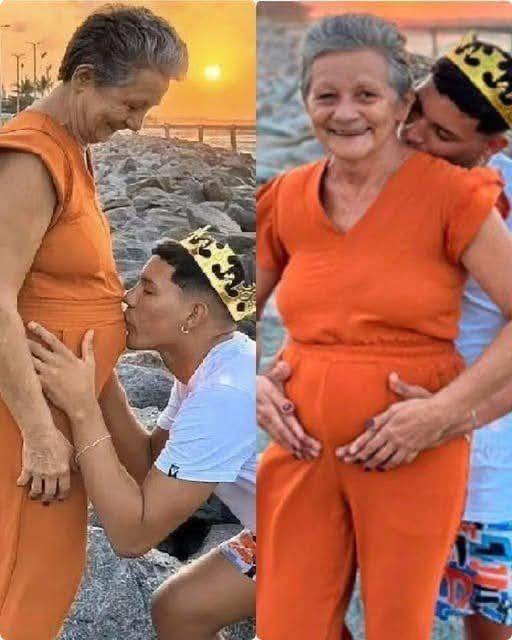
A Miracle… or Something More?
The Extraordinary Story of a 61-Year-Old Woman Who Discovered She Was Pregnant**
At the age of 56, she got the sort of news that would shock anyone to their very foundations. For most women, the onset of menopause is the signal that their reproductive days are over, a fact that is well understood both in terms of medical science and popular culture. But for this woman, whom we shall call Evelyn for the purposes of anonymity, this was about to be turned on its head in the most extraordinary way.
When she first discovered that she was pregnant, it would have been impossible for anyone to have predicted such a thing. Not her family, not her physicians, and not Evelyn herself.
She wept with joy, barely able to comprehend what was happening. “This is a miracle,” she told anyone who would listen. For all her life, she had dreamed of having a child, but fate had not been kind to her. “Years of infertility, heartbreak after heartbreak, and doctors who finally shrugged and said, ‘Accept it,’” she had thought. And then, out of the blue, hope appeared.
This is her story: a story of longing and loss, of science questioned and faith restored, of reactions from the community and change within herself. It is more than a strange news story or a viral sensation. It is a human story that challenges us to question everything we believe we know about age, biology, medicine, and what it means to hope.
A Lifetime of Waiting and Wondering
From her late twenties to her early fifties, Evelyn’s life had been a lifetime of waiting and wondering. She had married young, full of hope and dreams. Her husband, supportive and loving, had shared her dream of a family that would grow and flourish. But all these years had slipped by without a pregnancy. They had consulted specialists, tried treatments, procedures, and medicines—nothing had worked.
Infertility, especially in the earlier decades, was a kind of pain that was almost silent. There was no dramatic break or single moment of trauma. Rather, it was a slow accumulation of disappointment: another failed cycle, another failed month, another year of the annual visit with the disappointing test results and the hopeful conversation that always ended the same way. “Let’s try again,” the doctors would say. “Maybe next time.” But there was no next time.
Friends were having children, then grandchildren. She went to birthday parties, school plays, proms. She watched as babies were cradled, fed, and comforted. She smiled, hugged, and congratulated. But in her heart, the hollow pain continued.
It wasn’t until she was in her fifties that she had come to terms with the possibility that motherhood might elude her. She had come to think of a life without children not as a disappointment but as a fact. She had thought she had accepted it.
But life, it seemed, still had something in store that she could never have anticipated.
The Start of Something Truly Remarkable
It started with a peculiar series of sensations—fleeting, erratic, and unlike anything she had ever experienced before. Mild nausea, wave-like fatigue, sporadic abdominal pain. At first, she wrote these off as symptoms of stress, exhaustion, or mere menopause-related tomfoolery.
One afternoon, while rummaging through old documents, she came across an unused pregnancy test that she had squirreled away for reasons she couldn’t quite rationalize. On a whim, she decided to use it.
The outcome was immediate and astonishing: two solid lines, dark and unmistakable.
Her heart skipped a beat. She gazed at it in utter incredulity. Could it be? At her age? How? She double-checked it. And then checked it again.
Tears poured down her face—not of sadness, but of wonder and joy and utter incredulity. After all these years of waiting, a glimmer of hope kindled within her very soul.
“This is a miracle,” she whispered.
Confirmation and Medical Tests
Of course, this was merely the start. A positive home test result was hardly conclusive. Dubious yet hopeful, she made an appointment with her physician the very next day. The doctor, perplexed by her age and symptoms, suggested blood tests and then an ultrasound.
Neuroplasticity is the brain’s capacity to reorganize itself by creating new neural pathways. This is especially important in the early years of life, when the brain is undergoing synaptic pruning and myelination. Studies have shown that environmental stimulation and learning affect the thickness of the cortex and the branching of dendrites. Additionally, studies using functional magnetic resonance imaging have shown that the brain is highly plastic even in adulthood, allowing for recovery from injury and learning of new skills. The theory of neuroplasticity has many implications for educational psychology and rehabilitation medicine, suggesting that interventions can improve cognitive outcomes.
For some, the news was a real miracle, a defying of the laws of biology where hope won out. Others were more cynical, wondering if the tests were somehow wrong or if something strange was being misunderstood.
Then there was the social media element. The story went viral, with people discussing, speculating, criticizing, and celebrating. Some thought it a wonderful fluke. Others dismissed it as impossible or medically unlikely.
But for Evelyn, the opinions didn’t matter as much as the fact that she had discovered the truth about her own reflection: she was pregnant.
Scientific Skepticism and Medical Debate
The medical community reacted with a mixture of fascination, skepticism, and curious interest.
From a biological perspective, pregnancy at 56, or 61 for that matter, is highly unlikely. Most women go into menopause in their late 40s or early 50s, which signals the end of natural fertility. After menopause, the ovaries stop releasing eggs, making pregnancy impossible without assisted reproductive technology.
Some doctors speculated that Evelyn had “residual ovarian activity” or an “undiagnosed hormonal anomaly.” Others considered the possibility of a laboratory error or a medical phenomenon such as “molar pregnancy” or “embryo implantation of uncertain viability.”
Because of the unusual nature of the case, a series of confirmatory tests were conducted over the course of time, and all of them led to the same conclusion: pregnancy.
However, many experts warned against hasty conclusions, reminding the public that anomalies, although real, do not disprove established scientific knowledge. What Evelyn was going through, if true, was a statistical anomaly, so rare that most medical texts hardly give it a mention.
Everyday Life in the Midst of the Extraordinary
While the scientific community debated, Evelyn’s life moved into a new and strange phase.
She read about older pregnancies, medical risks, and prenatal care in advanced age. She tried to take things one day at a time, but each day seemed like a turning point.
Friends and family gathered around her. Some were supportive, while others were concerned. She had more appointments, more scans, and more questions than she had ever had in her life.
But she kept her focus on one thing: hope.
“I’ve always believed in motherhood,” she said. “Maybe not in the way I expected—but I believed.”
She walked with a different gait now, with her eyes opened to the world through the lens of wonder. Every sunrise was a gift. Every day was a fragile, precious thing. And the small life inside her, whether it was a biological occurrence or a miracle, gave her a reason to wake up with joy she hadn’t experienced in decades.
Ethics, Age, and the Public Discussion
As the news broke, public discussions about age, motherhood, and reproductive rights erupted.
Some people said that older maternal age is a medical risk—not only to the mother, but to the baby as well. Others cited the use of egg donation and IVF, which allow women to become pregnant later in life, and how this muddies the waters between natural and assisted reproduction.
Ethicists considered the consequences of late-in-life pregnancies:
Should age be a factor in reproductive freedom?
How do healthcare systems support or hinder women who become pregnant later in life?
What does it mean to strike a balance between risk and freedom?
The dialogue was rich, complex, sometimes understanding and sometimes critical. But one thing remained constant: Evelyn’s experience challenged people to think deeply about assumptions they never questioned before.
Personal Reflections: What It Means to Hope
For Evelyn, the experience became something much deeper than biology.
She talked about hope as a living thing—not something passive or foolish, but something active and persistent. Hope, she said, sustained her for decades when science had no answers.
“I never stopped believing,” she said. “Not because I was right, but because hope gave me a reason to keep trying, even when it seemed impossible.”
Her experience touched the hearts of people who had known loss, disappointment, or deferred dreams. It reminded them that life doesn’t always follow the script we write. Sometimes, it writes a different story altogether.
A Future Still Unwritten
As her pregnancy progressed, there were still questions.
Would it go to term?
What kind of health issues might she face?
What would life be like raising a child in her sixties or seventies?
There were no answers to these questions. But the mystery of her pregnancy, from longing to love, from improbability to possibility, had already changed her life and the lives of so many others.
She was a reminder not of the denial of science, but of the mystery that still exists despite our best understanding. Science can explain mechanisms and probabilities, but it cannot explain the human heart.
Final Thoughts
Evelyn’s story is more than just a 61-year-old woman’s assertion of pregnancy. It is a testament to the power of resilience. It is a testament to the struggle between what is statistically probable and what is possible. It is a testament to the human spirit’s ability to hope, to persevere, and to find meaning in the most unexpected of places.
Whether one considers it a statistical impossibility, a miraculous occurrence, or an incredible psychological odyssey, Evelyn’s experience is a call to continue to ask questions: What do we really know? How do we reconcile our doubts and our amazement? And most importantly, how do we continue to hold on to hope when life throws us a curveball that we never saw coming?